 |
|
|
|
|
|
 |
|
|
 |
 |
|
|
VoltMagic for R/C |
|
 |
 |
 |
||||||||||||||||||||||||||||||||||||||||||||||||||||||||||||||||||||||||||||||||||||
|
VoltMagic R/C Voltage Monitor with Glitch or Failsafe Counting and Peak Low Voltage. Super- Fast sampling and accuracy. VoltMagic uses a proprietary voltage indication algorithm that even works with 2-cell A123 / LiFe, as well as nearly all R/C servo-receiver Batteries (LiPo, LiFe, NiCd, NiMh), and Voltage Regulators or BEC.
See the
Video on YouTube
|
 |
4 or 5 cell NiCd or NiMh |
|
4.9 - 7.0 Regulator / BEC |
|
2 cell series A123 / LiFe (6.6) |
|
2 cell series Li (7.4) |
| Averaged Voltage / Battery Gauge with 20 ranges |
| |
|
Adjustable Peak Low Voltage ranges |
| 1200-1600 samples per second |
|
Glitch or Failsafe counting |
|
Calibrated within 0.015 volts |
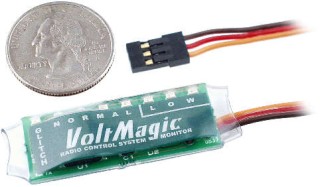
Designed & Assembled in the USA
VoltMagic 2Y-20 EX
Upgrade exchanges available. Do the DEMO...
|
Averaged Voltage (AV) —
An adjustable battery gauge,
to indicate low mAH remaining in a
battery, or incorrect output from a regulator. It shows a steady display of the
current voltage. Each LED represents a 0.1 volt step. 4-cell Nixx,
Regulator,
5-cell Nixx, 2-cell A123
and Lithium
each have multiple ranges.
One monitor for all applications, plus you can fine-tune the colored
LED bar graph to match your system, and your personal preference.
[Table
1] Click to expand the example graph. |
| Peak Low Voltage (PLV) — This is what indicates whether the electrical system is capable enough for the servos. Below a certain threshold, shows the lowest voltage at the receiver (or wherever it’s connected) in 0.1 volt increments [Table 2]. There are two ranges, Normal or Low, to select from. The Extended PLV feature temporarily shows an extra 0.2 volts of PLV range on the high end for an early warning, displayed on LED 5 if the switch VoltMagic is connected to is toggled quickly 5 times (after 1 minute of run time). The new EX version sample rate is 1200-1600 per second. The fastest on-board monitor available. |
| Overvoltage (OV) — For regulated systems, shows if the voltage went above a certain threshold [Table 2] which would indicate an overvoltage failure of a regulator / BEC. |
|
Glitch and Failsafe Counting — Selectable for Glitch (PPM) or Failsafe (PCM or 2.4 GHz with an adjustable failsafe). The counting is smart, so several within a short time period are counted as the same glitch. [Table 3] A glitch (missing or bad signal pulse) from a PCM or 2.4 GHz receiver indicates a fault (possibly a reboot). With a traditional PPM receiver, a glitch usually indicates a failure to receive the transmitters signal. |
|
Data Logger — This feature plays back any PLV / OV plus any Glitch or Failsafe counts from the previous flight when the power is turned on. |
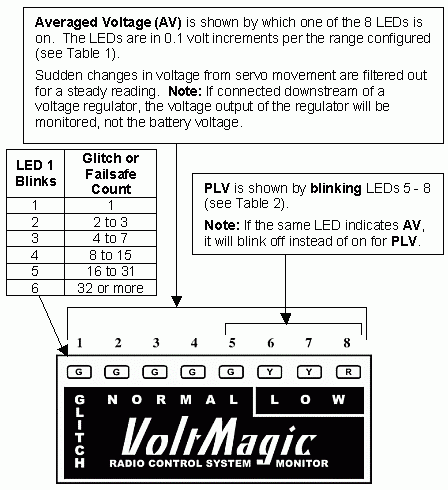
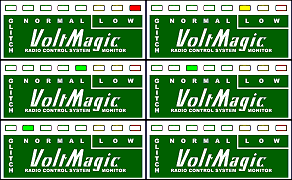
See Table 1 and Table 2 for the available voltage trigger points for each range. (The version with 2 yellow LEDs is depicted. The 2 red LED version operates similarly, LED 7 being red instead of yellow.)
| LED 8 | AV extra Low |
1-2 blinks = PLV extra Low |
| LED 7 | AV very Low | 2 blinks = PLV very Low |
| LED 6 | AV Low | 1-2 blinks = PLV Low |
| LED 5 | AV Normal | 1-2 blinks = PLV near Yellow or OV |
| LED 4 | AV Normal | |
| LED 3 | AV Normal | |
| LED 2 | AV Normal | |
| LED 1 | AV Normal | Blink = Glitch (Failsafe) count |
AV = Averaged Voltage PLV = Peak Low Voltage OV = Over Voltage
At least one LED will always be lit showing AV. Normally, that's all you should see. You could have up to three LEDs lit at one time: one showing the AV (any of the LEDs), one blinking to show the PLV or OV (LEDs 5-8), and one blinking the Glitch/Failsafe count (always LED 1). If the AV is lighting up the same LED that blinks, it will blink off quickly instead of on.

|
Application: Battery types: 4 or 5 cell Nixx (NiMh / NiCd), 2 cell A123 (LiFe), 2 cell Li (Lithium), 4.9 to 6.2 and 6.7 to 7.1 voltage regulators. 20 ranges for averaged voltage, each with 2 peak low voltage ranges. |
|
Input Voltage: 2.8 to 8.5 VDC |
| Voltage Sample Rate: 1200-1600 per second |
|
Frame Rate: 12 to 23ms (for glitch & failsafe detection) |
|
Connector: Universal (Futaba, JR, Z). |
| Accuracy: Calibrated within 0.015 vdc. |
|
Weight: 7.3 grams (1/4 OZ) |
|
Size: 48 x 19.5 mm, and 5 mm thick (1.89" x 0.77", and 0.20" thick). |
|
NO switches or pots to fail, all configuration is via your transmitter. |
|
Warranty: Two years |
Specifications subject to change and/or improvement. For previous versions, please download the appropriate instructions.
Modern servos for radio control are more powerful then ever, and they draw more peak current then ever too. A battery can have a good charge, yet the voltage can dip quite low. Voltage regulators have their limitations. There can also be excessive voltage drop in wiring, connectors and switches.
There are no rules of thumb that always work to select batteries or regulators. Peak amps differ substantially between servos. Voltage drop under load differs greatly among batteries that have similar ratings. Regulators typically have amperage ratings, but what are the peak servo amps, and can the supply battery keep the input voltage sufficiently above the output? Can the regulator handle fast transient load changes of your servos?
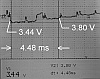
The only way to know how low the voltage really goes is to check it with a high speed monitor like VoltMagic.
It is not uncommon for a pilot to be shocked at the peak low voltage after installing VoltMagic on a model that had been flying well. Typically there are no symptoms, until something finally draws the voltage down a little further.
A less obvious advantage of being warned about peak low voltage is that troubleshooting intermittent problems becomes easier when you can either rule out low voltage, or seek the cause of it and verify a repair before flying. Even if your setup is very tolerant of voltage drop, a unusual decrease might indicate a battery cell, regulator, switch, or connector going bad. Low range PLV works well in situations where the voltage drop normally runs high.
Another advantage is stirring the sticks on pre-flight. Quickly reversing the direction of servos produces current spikes (and voltage dips) that are similar to flying (but shorter in duration). VoltMagic has a very fast sample rate, so you'll likely catch peak low voltage problems on pre-flight.
Under voltage on 2.4ghz receivers is notable for the time to re-link with the transmitter. XPS lists their voltage requirements at xtremepowersystems.net. The Spektrum receiver power requirements are detailed in this article at spektrumrc.com. To summarize this article, 3.5 volts minimum operational voltage. There are also guidelines and procedures for testing both current and minimum voltage to check that there is a sufficient safety margin.
VoltMagic makes this kind of testing easier, and more accurate (because it's a high speed monitor that captures the lowest voltage). You can also stir the sticks before every flight and check the peak low voltage (minimum voltage), plus it monitors while you fly.
 |
 |
 |
|
Is
My Radio's Power Supply Adequate?
Troubleshoot low PLV with this FAQ. It's high speed sample rate will record the actual lowest voltage that other monitors and data loggers just miss. Why is this important? When you stir the sticks on the ground (quickly reversing the servo motors), peak current and peak low voltage will be close to in-flight values. However, the duration of the voltage dips will be shorter. Slower volt meters, monitors and data-loggers miss these dips because they don't sample often enough. With VoltMagic you can stir the sticks and get comparable readings to in-flight, WITHOUT THE RISK. It makes a great pre-flight check.
Averaged Voltage is
Peak Low Voltage can detect problems with batteries,
switches, wiring, servos, etc. Great for
monitoring the output of a voltage regulator or BEC.
|
||
 |
 |
 |
VoltMagic - Don't take off without it.
Copyright VoltMagic.com












 March 2011: VoltMagic
EX released and in stock at
March 2011: VoltMagic
EX released and in stock at 
)
)
)